Last updated April 2026
One of the biggest advantages healthcare professionals have is access to financing that looks very different from traditional small business lending.
Banks often view physicians, dentists, and other licensed providers as a distinct category of borrower. Because of their earning potential, demand stability, and repayment track record, many lenders have built specialized programs, some of which include up to 100% financing for practice acquisitions, buy-ins, startups, and even personal home purchases.
But “100% financing” doesn’t mean what most people think and it’s not always the right move.
In our experience, most first-time buyers focus too much on whether they can get 100% financing and not enough on whether they should.

Quick Answer: Can Healthcare Providers Get 100% Financing?
Yes many lenders (such as Huntington Bank) will offer up to 100% financing for qualified healthcare professionals, especially for:
Buying an existing practice
Buying into a group
Certain equipment or buildout costs
However, approval comes down to:
Your credentials and experience
The strength of the practice
Your overall financial position
👉 Simple version:
The more proven and visible the deal is, the more comfortable a bank becomes financing it fully.
What 100% Financing Actually Means (In Plain English)
When lenders say 100% financing, they are typically saying:
“We’re willing to fund the full project cost without requiring a traditional down payment if the deal holds up.”
What it can include:
Practice purchase
Buy-in ownership
Equipment
Tenant improvements
Sometimes working capital
What it does NOT mean:
No underwriting
No credit requirements
No need for cash reserves
No risk to you
What this means for you:
You may not need to bring $100K–$300K+ upfront
You can preserve cash for:
Living expenses
Ramp-up period
Unexpected costs
👉 Key takeaway:
100% financing is not “easy money” it’s confidence-based lending tied to your profile and the deal itself.
When You’re Most Likely to Qualify for 100% Financing
Not all deals are viewed equally.
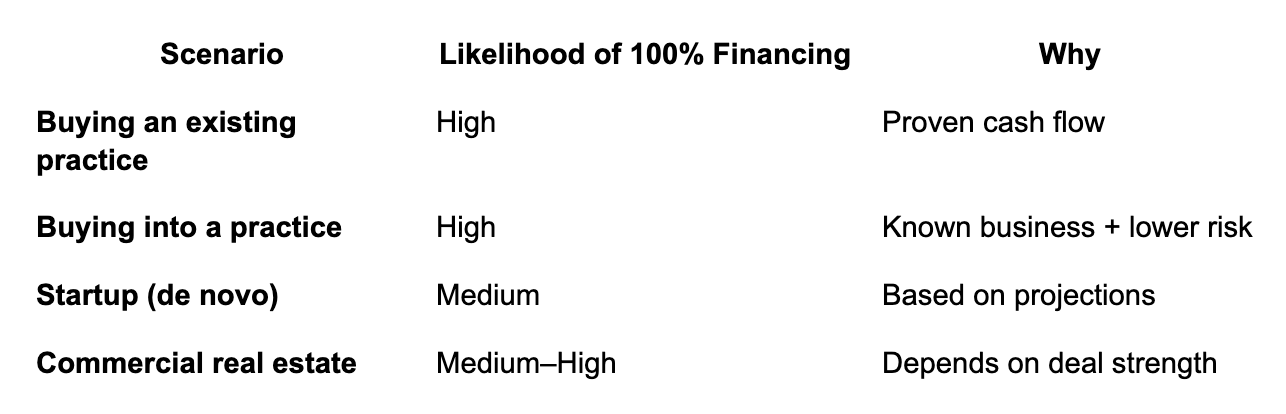
👉 What this means for you:
If leverage is important, buying or buying in is usually far easier to finance than starting from scratch.
Why Buy-Ins and Acquisitions Are Easier to Finance
This is where lenders think very differently than most providers expect.
Startup practice
The bank is evaluating:
Will patients come?
Will revenue ramp fast enough?
Will everything execute correctly?
👉 Translation: more unknowns = more risk
Buy-in or acquisition
The bank can see:
Real patient volume
Historical collections
Staff already operating
Proven location
👉 Translation: less guessing = more confidence
What this means for you:
When you buy or buy in:
You’re stepping into an existing system that works
You’re reducing uncertainty for the lender
That’s why banks are more willing to:
Offer higher leverage (including 100%)
Provide better terms
Move faster
A Real-World Example
Dentist A: Startup
New office
No patients yet
Full buildout + marketing
👉 Bank view:
“We’re betting on projections”
Dentist B: Acquisition
$800K purchase
~$200K earnings
Established patient base
👉 Bank view:
“We can see exactly how this performs”
Result:
Dentist B is far more likely to:
Get 100% financing
Receive stronger terms
Close faster
👉 The rule is simple:
The more a bank can see, the more it’s willing to lend.
What Lenders Actually Care About (Even With 100% Financing)
Even in specialized programs, lenders still look at fundamentals.
Typical benchmarks:
DSCR: ~1.20x–1.30x+
Global cash flow: total income vs obligations
Liquidity after closing
They’re evaluating:
You
Credentials
Experience
Credit
The business
Cash flow or projections
Patient mix
Location
The deal
Structure
Working capital
Sustainability
👉 Important:
100% financing doesn’t remove risk, it shifts how the bank evaluates it.
How This Impacts Your Personal Financial Life
This is where people get surprised.
At the same time you’re:
Buying a practice
Taking on business debt
You may also want to:
Buy a home
Yes, you can often do both
Healthcare-specific loan programs may allow:
Low or no down payment
No PMI in some cases
Flexibility with student loans
But here’s the reality:
We’ve seen situations where someone gets approved for both a practice and a home and feels financially tight within 6–12 months because no one walked through the full picture.
What you should actually think about:
Monthly obligations after closing
Cash left in the bank
Time to stabilize the practice
Lifestyle costs
👉 Approval is not the hard part. Living with the decision is.
Where People Get This Wrong
This is where mistakes tend to happen:
Chasing 100% financing because it sounds good
Not thinking about life after closing
Assuming all lenders evaluate risk the same way
Underestimating how long a startup takes to stabilize
👉 The biggest mistake:
Optimizing for approval instead of optimizing for sustainability.
How to Approach Financing the Right Way
The strongest borrowers think beyond just getting approved.
1. Talk to multiple lenders
Not all banks think the same, especially in healthcare.
2. Understand your full financial picture
Not just the loan, your entire balance sheet.
3. Don’t chase max leverage blindly
Sometimes less leverage = better flexibility.
4. Align financing with your stage
Startup → more conservative
Buy-in/acquisition → more aggressive options
5. Protect your liquidity
Especially in the first 12–24 months.
Frequently Asked Questions About Healthcare Practice Financing
Can dentists get 100% financing to buy a practice?
Yes many lenders will offer up to 100% financing for qualified borrowers purchasing established practices with strong cash flow.
Is it easier to finance a buy-in or startup?
Yes. Buy-ins and acquisitions are typically easier because they have proven revenue.
Can I buy a practice and a home at the same time?
Yes but managing total debt and liquidity is critical.
Do I need any money at all?
Not always but having reserves is still important for stability.
Final Thoughts
Healthcare financing is different because healthcare risk is different.
That’s why:
Banks offer specialized programs
Some allow up to 100% financing
Approval can look very different than traditional lending
But the real question is not:
“How much can I borrow?”
It’s:
“What structure sets me up to succeed long-term?”
Because on paper, a deal can look perfect.
In real life, it has to feel manageable every month.