Last updated April 2026
Most providers think a good location means strong traffic, high visibility, or being in a fast-growing area. In healthcare real estate, those factors matter but they rarely determine whether a practice actually performs. The difference between a location that quietly struggles and one that consistently produces patient demand usually comes down to how well it aligns with demographics, competition, patient behavior, and long-term strategy.
In this guide, we break down how to think about site selection the right way, including how to evaluate your practice model before touring space, what demographic data actually drives revenue, how to measure competition and market saturation (not just count providers), why accessibility often matters more than visibility, and how lease structure can impact your growth long after opening day.

Fun Fact: Does Urgent Care need visibility or drivability more?
Drivability matters more for someone who needs help fast, and you can choose to remain visible in online reviews more than frontage road, which can give you more options for where to locate.
Why Site Selection Matters More Than Most Providers Realize
Many practice owners understandably focus on the obvious early priorities: financing, staffing, equipment, licensure, branding, and opening on time. Those are all critical. But the location decision sits underneath all of them.
A weak site can force the practice to work harder for every new patient. It can increase marketing costs, slow growth, reduce convenience, and make even a clinically strong operation feel harder to scale. A strong site does the opposite. It creates tailwinds.
A good location can improve:
New patient acquisition
Patient retention and repeat visits
Referral consistency
Provider productivity
Long-term practice value
A poor location can quietly hurt:
Schedule fill rates
Treatment acceptance
No-show and cancellation patterns
Online reviews tied to convenience
The economics of future growth
Unlike marketing, staffing, or operations, location is one of the hardest variables to fix after the fact. A practice can change ad spend, retrain the front desk, or improve patient follow-up. Moving a built-out medical office is far more expensive and disruptive. That is why the upfront analysis matters so much.
Start With the Practice Model, Not the Property
One of the most common mistakes in healthcare real estate is starting with the space itself. A provider tours a few properties, compares rent, likes the feel of one center over another, and starts evaluating from there.
That sequence is backwards.
The best site searches begin by defining the practice model, because different specialties need different things from a location. A startup general dentist should not evaluate sites the same way an orthodontist, oral surgeon, pediatric practice, med spa, orthopedic clinic, or primary care office would. Their patient behavior, referral dependency, visit frequency, and acceptable travel radius are all different.
Before narrowing any sites, a provider should be able to answer a few basic questions:
What type of patient is the practice trying to serve?
Is the target base primarily:
Families with children
Working professionals
Retirees
Referral-based specialty patients
Medicaid populations
Cash-pay or elective patients
How will those patients find the practice?
Will growth come from:
Digital marketing
Word of mouth
School and neighborhood proximity
Physician referrals
Employer density
Visibility and convenience
How often will patients return?
A dental hygiene-driven general practice depends heavily on repeat visits. A surgical specialty may have a different cadence. A med spa may rely more on consumer behavior and discretionary spend. Those patterns affect how important access, parking, and demographic fit really are.
How referral-dependent is the model?
A highly referral-based specialty may tolerate a less visible site if the referral network is strong. A de novo general practice usually has much less room to compromise on accessibility and local patient density.
The site should fit the model. Not the other way around.
Demographics Are More Than Population Growth
Population growth gets cited constantly in site selection conversations, especially in Texas, and for good reason. But growth alone is not enough. The more important question is whether the people moving into an area actually match the economics of the practice being built.
That is where many providers get tripped up.
A fast-growing submarket may look compelling because rooftops are going up, retail is following, and everyone is talking about it. But if the incoming population skews younger renters, more transient households, or lower healthcare utilization patterns than the practice needs, the site may underperform despite the momentum.
A better demographic review looks beyond raw population and asks:
What does the patient base actually look like today?
Current population within realistic drive times
Age distribution relevant to the specialty
Household income levels and distribution
Insurance characteristics where available
Owner-occupied versus renter-heavy housing patterns
Daytime population and nearby employers, if relevant
What is likely to change over the next 3–5 years?
Projected population growth
New residential delivery
Employer movement into or out of the area
School growth and family formation trends
Retail and infrastructure expansion
Does that profile fit the practice model?
This is where nuance matters.
A pediatric practice may value family density and school adjacency more than a premium retail corridor. A general dental office may care deeply about household income, employer-based insurance, and stable residency. A cash-pay med spa may prioritize a very different profile altogether.
Not all growth is good growth. And not all “good” demographics are good for every specialty.
A Real-World Example: Two Growing Areas, Two Very Different Outcomes
Imagine a startup general dentist evaluating two sites in Central Texas.
Site A is in a newly developing corridor with visible growth, plenty of new home construction, and strong traffic counts. It looks exciting. But much of the housing stock is still being delivered, the commercial base is immature, and the income mix is inconsistent.
Site B is a little less flashy. It is near established neighborhoods, strong schools, stable owner-occupied housing, and a higher percentage of households with commercial insurance. Traffic is lower. Visibility is a little weaker. But access is simple, and the population base is already there.
A first-time operator may be tempted by Site A because it feels like the future. In many cases, the better business decision is Site B. Why? Because it offers more immediate patient demand, more predictable insurance economics, and less dependence on future growth arriving exactly as projected.
That is one of the biggest lessons in healthcare site selection:
The site that looks best to a first-time buyer is often not the site that performs best over time.
Competition Should Be Measured, Not Guessed
Many providers evaluate competition informally. They search online, drive the area, count nearby practices, and form a general impression. That is better than doing nothing, but it is not enough to make a major real estate decision.
What matters is not simply how many competitors exist. What matters is how supply compares to demand inside the actual trade area.
An area can feel crowded yet remain attractive if patient demand is strong, the growth curve is healthy, and the provider-to-population balance remains favorable. On the other hand, an area with only a few obvious competitors can still be functionally oversupplied if those operators are entrenched and the patient base is thin.
A strong competition analysis should ask:
How many similar providers exist within the realistic patient trade area?
That may mean 1-mile, 3-mile, and 5-mile rings, or it may mean a drive-time analysis depending on the market and specialty.
What is the patient-to-provider ratio?
This is where the conversation becomes more useful. A trade area with one provider per 1,200 likely patients is very different from one with one provider per 2,500 or 3,000. The exact thresholds vary by specialty and local market behavior, but the principle is the same: saturation matters more than simple presence.
Who are the competitors?
Independent practices
DSOs
Hospital-backed groups
Aggressive growth operators
Mature practices that may already control referral channels
What does the market feel like operationally?
Are competitors likely full and capacity-constrained? Are they marketing heavily? Are new providers entering because demand is strong, or because everyone is chasing the same growth story?
What is changing nearby?
A site may look acceptable today, but become far more competitive once adjacent retail and rooftops deliver and attract additional operators.
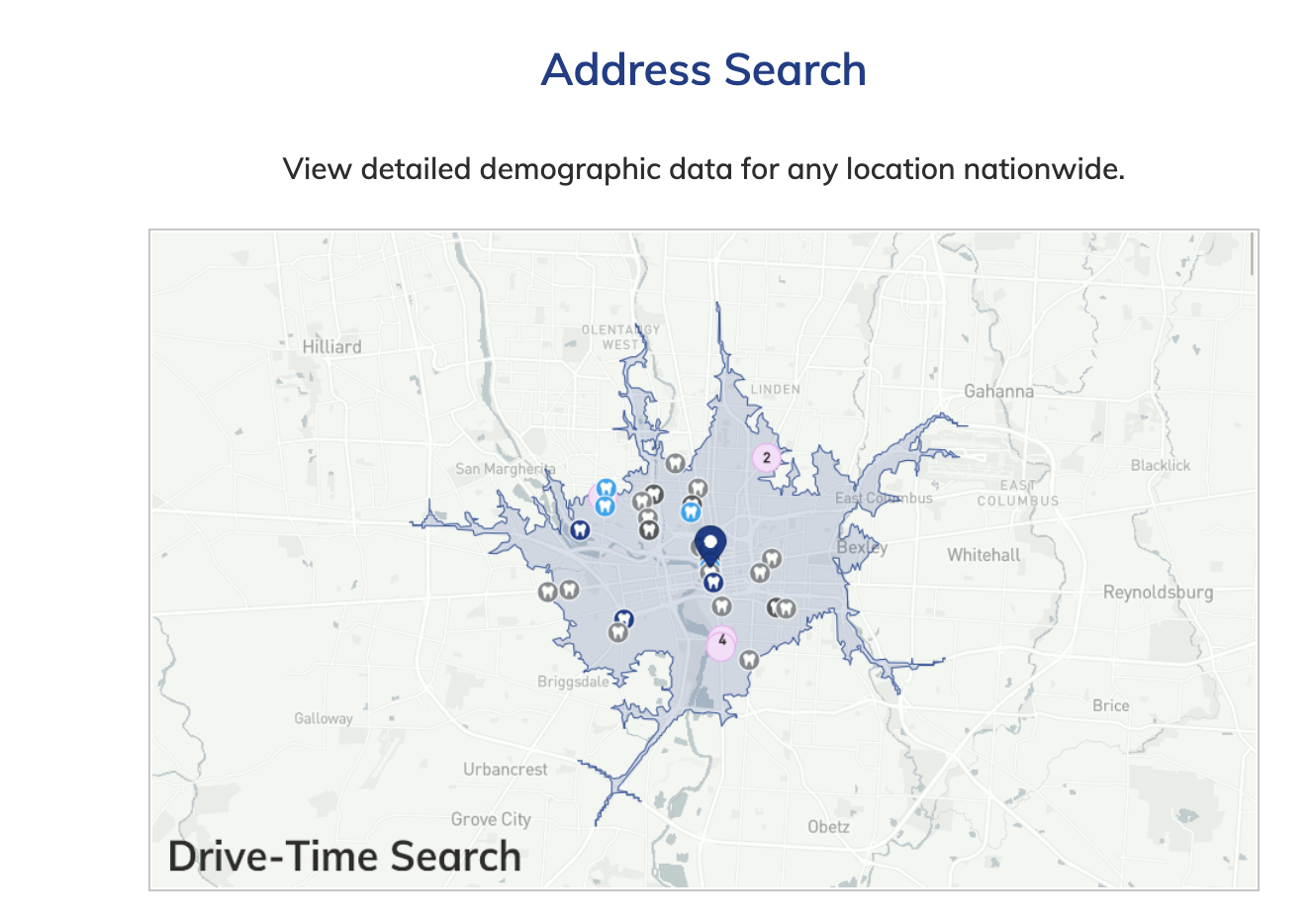
Why Dentagraphics Matters for Dental Site Selection
For dental specifically, tools like Dentagraphics can make the analysis meaningfully sharper.
Instead of relying on anecdotal observations like “there seem to be a lot of dentists over there,” a more disciplined review can look at:
Provider counts within defined trade areas
Population-to-dentist ratios
Concentration of competing offices
Pockets of over- or under-supply
How one corridor compares to another
That does not eliminate the need for judgment. It does, however, make the site search more grounded. It helps separate markets that merely feel active from markets that actually have room for another operator.
That is especially important in dental, where a provider may assume a booming suburb is underserved simply because everything is new. In reality, that same suburb may already have a dense cluster of general dentists opening alongside the same rooftops.
Data will not make the decision for you. But it can keep you from making the wrong one, and according to the American Dental Association, practice ownership trends continue to evolve, so it will be interesting what AI does to business and practice ownership.
The Best Opportunities Are Often in the Less Obvious Pocket
One of the most useful things a real competition and demographic review can reveal is that the best opportunity is not always in the highest-profile corridor.
The hottest pocket in a metro often attracts:
The most development attention
The most rooftops
The most excitement
The most providers
The most competition for the same patient base
Meanwhile, a neighboring submarket may have:
Less hype
Better patient-to-provider balance
Stronger current demographics
Easier access
More rational lease economics
That is where discipline matters. Practices that perform well over time are not always the ones that choose the market with the most buzz. They are often the ones that choose the micro-market where supply and demand actually make sense.
Visibility Is Helpful. Accessibility Is Usually More Important.
High-traffic frontage is one of the most overvalued site attributes in healthcare real estate. It sounds intuitive: more visibility should mean more patients. In practice, healthcare does not work like impulse retail.
Patients are not usually choosing a dentist or physician because they happened to notice a sign while driving by. They are choosing based on:
Insurance acceptance
Referrals
Reviews
Reputation
Convenience
Scheduling ease
That last one matters more than many providers realize.
A highly visible site can still underperform if the arrival experience is frustrating. Patients may struggle with:
Left turns across heavy traffic
Limited or confusing parking
Congestion in multi-tenant retail centers
Difficult drop-off flow for children or elderly patients
Indirect or hidden access from the road
That friction adds up. It affects the first impression. It affects patient satisfaction. It affects the likelihood of someone returning and recommending the practice.
A slightly less visible site with:
Easy ingress and egress
Ample parking
Clear visibility at the point of decision
A straightforward path from car to suite
will often outperform a more prominent location that is inconvenient in real life.
Visibility may help a patient find you once. Accessibility helps them come back.
A Simple Patient Test for Any Site
One of the easiest ways to pressure-test a healthcare location is to stop thinking like an owner and start thinking like a patient.
Ask:
Can I get in and out without stress?
Is the parking obvious and close to the entrance?
Would a first-time visitor find the suite easily?
Would I be comfortable bringing a child, a stroller, or an older parent here?
Does the center feel calm, or chaotic at peak hours?
This is particularly important for pediatrics, family medicine, general dentistry, orthodontics, and any concept serving patients who value convenience and predictability.
A site can look excellent in a leasing package and still fail this test.
Lease Strategy Is Part of Site Selection, Not a Separate Step
A provider can choose the right geography and still make a poor overall decision if the lease is not structured properly. That is why lease review should not happen after the site is selected as an afterthought. It should be part of the site selection process itself.
Healthcare users face a different risk profile than many office or retail tenants because:
Buildouts are expensive
Specialized layouts create relocation friction
Equipment and plumbing can materially increase upfront cost
Operational disruption from moving is significant
Growth can happen faster than expected in a good location
A meaningful lease review should include:
1. Tenant improvement economics
Medical and dental buildouts are often more expensive than a provider expects. Face rent is only part of the equation. The real question is how much capital the practice is putting into the space and what the landlord is contributing.
2. Expansion flexibility
If the practice grows, can it take adjacent space? Are there any rights of first refusal or first offer? It is not uncommon for a practice to outgrow its initial footprint within 24–36 months.
3. Use protection
Where available, exclusive language can matter. A provider investing heavily in signage, marketing, and buildout generally does not want a direct competitor added nearby in the same center.
4. Long-term economics
Renewal options, escalation language, operating expense pass-throughs, assignment rights, and relocation clauses all affect the long-term quality of the site decision.
A good location with weak lease terms can still become a bad deal.
A good location with strong lease protection becomes a much stronger business asset.
Texas Creates Opportunity, but It Also Punishes Lazy Analysis
Texas remains one of the most attractive healthcare growth markets in the country. Population migration, business expansion, and suburban development continue to support new practice formation across much of the state. But those same growth dynamics can create false confidence.
In high-growth markets, it becomes easy to assume that almost any decent site will eventually work. That assumption is dangerous.
Along the Austin–San Antonio corridor in particular, it is common to see two nearby submarkets with very different realities:
One may have stable household formation, strong employer presence, and immediate patient demand
Another may have great headlines and active development, but a slower real-world ramp and more speculative patient economics
The providers who make the strongest location decisions in Texas are usually not the most aggressive. They are the most disciplined. They are willing to:
Challenge assumptions about growth
Look past broad metro-level trends
Compare micro-markets instead of just cities
Walk away from highly visible sites that do not fit the model
Favor fundamentals over hype
That discipline may not feel exciting at the beginning. Over time, it is often what creates a healthier, more valuable practice.
What a Strong Site Selection Process Should Include
For providers evaluating where to open, relocate, or expand, a strong process usually includes the following:
Define the practice model clearly
Know the target patient, referral dependency, payer considerations, and expected frequency of visits.
Map the real trade area
Do not rely only on zip codes or city names. Evaluate realistic drive times and patient movement patterns.
Study demographics in layers
Look at current population, projected growth, age, income, insurance characteristics, housing stability, and nearby employers.
Analyze competition quantitatively
Measure provider density and supply-demand balance rather than relying on quick impressions.
Pressure-test convenience
Evaluate access, parking, traffic flow, signage, and real-world usability.
Model the lease like part of the investment
Face rent is not the full story. Buildout cost, tenant improvement allowances, flexibility, and protections matter.
Separate exciting from sustainable
A fast-growing area is not automatically the right area. The right location is the one that fits the actual economics of the practice.
Final Thoughts
The most successful healthcare practices do not choose locations casually. They approach site selection as a strategic decision that affects far more than rent. It shapes patient demand, operating efficiency, marketing performance, retention, and the long-term value of the business.
That is why the strongest site decisions come from combining demographic analysis, competition review, patient behavior, convenience, and lease strategy into one process. For dental groups, tools like Dentagraphics can add important clarity around saturation and trade-area dynamics. More broadly, the principle applies to any healthcare provider: the right address is not just a place to operate. It is a platform for growth.
In many cases, the site that feels most exciting at first glance is not the one that will perform best over time. The strongest locations are usually the ones backed by the clearest logic, the best fit, and the most disciplined analysis.
The address matters. But the analysis behind the address matters more.